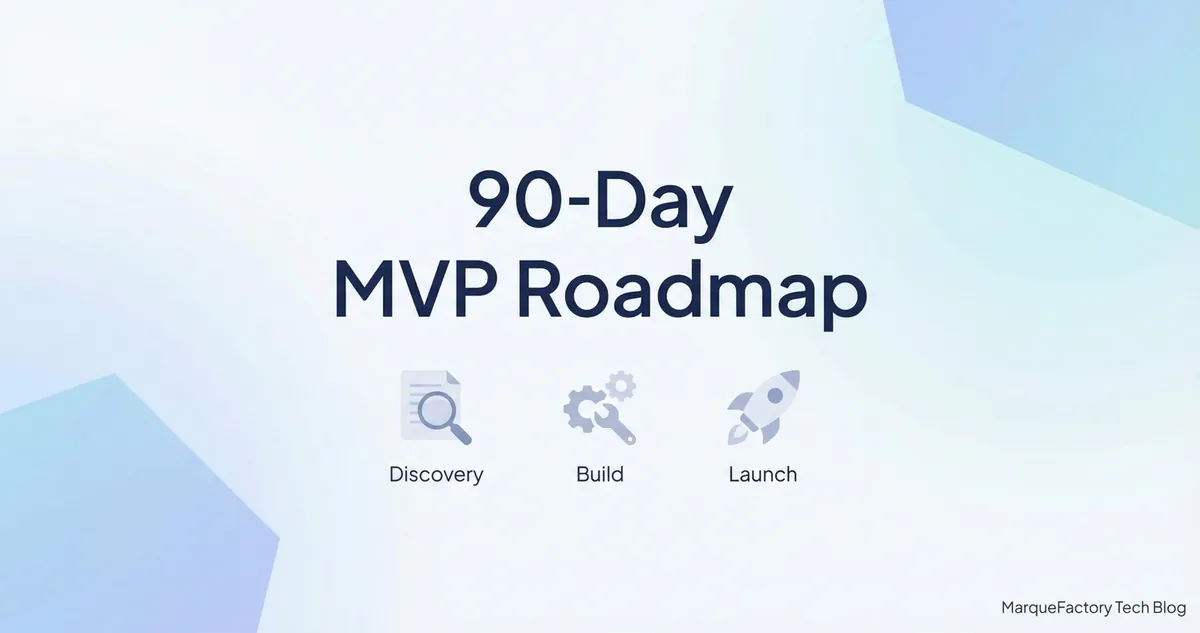
From Idea to MVP in 90 Days: A Realistic Roadmap for Startups
You have an idea. You want to validate it with real users as fast as possible—without overspending or building the wrong thing.
A 90-day MVP is achievable if you focus on one core workflow, one primary user, and one clear outcome.
This article gives you a realistic roadmap and what to expect at each stage so you can plan (or brief a development partner) with confidence.
What “MVP in 90 days” really means
MVP = Minimum Viable Product: the smallest version of your product that delivers real value and lets you learn from real users.
In 90 days you typically get:
- A working product (web app or mobile app) that one core user type can use
- One main flow done well (e.g. sign up → do the key action → see a result)
- Basic auth, roles, and data so you can onboard and support early users
- Deployment and handover so you can run and iterate
You do not get: every feature, every integration, perfect design, or scale for millions. That comes later.
Phase 1 — Discovery & scope (Days 1–14)
Goal: Lock down who the product is for, what one job it does, and what “done” looks like for v1.
Week 1–2
- Define the primary user
One persona (e.g. “small business owner who needs to schedule jobs”). - Write the core user story
“As a [user], I want to [do one thing] so that [outcome].” - List must-have vs nice-to-have
Must-have = needed for first real users. Everything else is later. - Sketch or wireframe the main flow
Even on paper: screens and steps for that one flow. - Choose a tech direction
Web vs mobile, and any constraints (e.g. must work offline, must integrate with X).
Output: A short scope document (1–2 pages) that a development team can estimate from.
Phase 2 — Architecture & design (Days 15–35)
Goal: Agree on structure, data model, and UX so build doesn’t stall on “we didn’t think of that.”
Week 3–4
- Data model
Main entities (e.g. User, Project, Booking) and relationships. - API or backend boundaries
What the frontend will call; what’s stored where. - Key screens
Main flow only: 5–10 screens max for MVP.
Week 5
- UI direction
Simple wireframes or a clean UI kit. No need for pixel-perfect design; focus on clarity and usability. - Timeline and milestones
e.g. Week 6–7: auth + core flow; Week 8–9: polish + integrations; Week 10–12: test + deploy.
Output: Architecture that’s good enough to build and a shared timeline with your team or partner.
Phase 3 — Build (Days 36–75)
Goal: Ship the core flow in small, testable chunks.
Typical MVP build (6–8 weeks)
- Weeks 1–2: Auth (sign up, login, basic roles), database setup, main entities.
- Weeks 3–4: Core feature (the one job the product does), plus basic CRUD and list/detail views.
- Weeks 5–6: Integrations (e.g. one payment provider, one email or notification), basic admin or settings.
- Weeks 7–8: Bug fixes, edge cases, performance and security checks, deployment setup.
Best practice: Demo every 1–2 weeks. Avoid “big bang” at the end. If you’re working with a remote team, short sync calls and a shared backlog keep everyone aligned.
Phase 4 — Launch prep & deploy (Days 76–90)
Goal: Go live with a stable product and a way to support users.
- Staging testing
Run through the main flow yourself and with 1–2 friendly testers. - Production deploy
Hosting, domain, env vars, secrets. Prefer a simple, repeatable process (e.g. one command or pipeline). - Monitoring
At least: errors and basic uptime. Optional: simple analytics or event tracking. - Handover
Code access, docs, and “how to deploy” so you or your team can iterate.
Output: A live MVP and a clear path to post-launch improvements.
What makes 90 days realistic (and what blows it up)
Realistic when:
- You have one primary user and one core workflow.
- Scope is fixed for the 90 days (new ideas go into “v2”).
- You have one decision-maker and a responsive dev team or partner.
- You’re okay with “good enough” design and minimal integrations.
It blows up when:
- You add “just one more” feature every week.
- You target multiple user types or multiple products in the same 90 days.
- You change direction mid-build without adjusting timeline or scope.
- You skip discovery and expect the team to guess.
AI-accelerated MVP: when can you do it in 4–6 weeks?
AI tools (code assistants, generators, and LLMs) can speed up parts of MVP development—so you might hear “we can do it in a few weeks.” Whether that’s realistic depends on what you mean by “done.”
Where AI actually shortens the timeline
- Boilerplate and scaffolding
Auth, CRUD, forms, and standard UI can be generated or drafted quickly. An experienced developer using AI can get a working prototype in 2–4 weeks. - First drafts
Copy, placeholder content, and simple docs can be produced in hours instead of days. - Repetitive patterns
List views, detail pages, and simple APIs are faster when AI suggests structure and you refine it.
So: a clickable, internal demo or narrow prototype in a few weeks is achievable with AI in the loop.
What still takes time (and doesn’t shrink to zero)
- Scope and decisions
You still need a clear “one user, one flow” and timely answers. AI doesn’t replace that. - Security and auth done right
Passwords, sessions, and permissions need review and testing—not just generated code. - Edge cases and real data
Validation, errors, and “what if the user does X?” take testing and iteration. - Your feedback
Demos, changes, and sign-off still depend on your availability.
So: turning a prototype into a reliable, shippable MVP that you’d put in front of paying users usually adds another 2–4 weeks of hardening, testing, and deployment.
When “MVP in a few weeks” is realistic
A 4–6 week MVP is realistic when:
- The scope is very small: one primary user, one main flow, minimal integrations.
- You have one decisive stakeholder and fast feedback (e.g. daily or every few days).
- You’re okay with a “v1 then iterate” product: secure and usable, but not polished everywhere.
- The team uses AI for speed but still does proper review, testing, and deployment.
When it’s risky
Promises like “full MVP in 2 weeks” are risky when:
- The scope is vague or includes multiple user types and flows.
- No time is planned for security review, testing, or your feedback loops.
- The plan assumes “AI writes it, we ship it” with no hardening phase.
Bottom line: AI can get you to a demo or prototype in weeks, and with tight scope and good process, a shippable MVP in 4–6 weeks is possible. A robust, production-ready product in 90 days is still the safer default for most ideas—AI just makes each phase faster and leaves more room for iteration.
Working with a development partner on a 90-day MVP
A good partner will:
- Ask who the product is for and what one job it does.
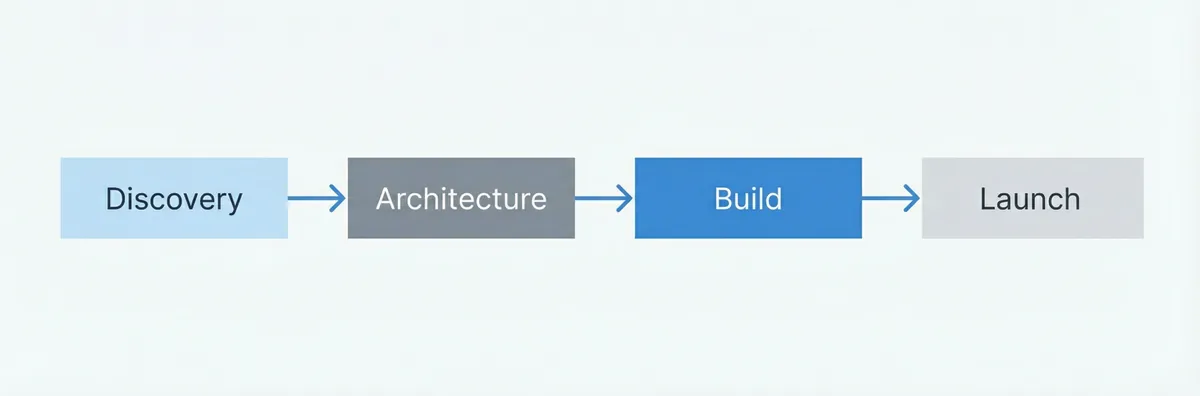
- Propose a phased plan (discovery → build → deploy) with clear milestones.
- Demo often and flag scope creep early.
- Deliver something you can run after 90 days, not just code.
You should expect:
- A fixed or capped scope for the 90 days.
- Transparent progress (e.g. weekly updates, access to backlog).
- Documentation and handover so you’re not locked in.
Final thoughts
A 90-day MVP is a powerful way to test an idea with real users without overbuilding or overspending.
Success depends on focus: one user, one flow, one clear outcome—and the discipline to keep scope stable for those 90 days.
If you’re ready to turn your idea into a launchable product in roughly 90 days, the next step is a short discovery conversation to align on scope and timeline.
Want a 90-day MVP built for you?
At Marquefactory, we help startups and small businesses go from idea to launchable MVP with clear milestones, modern tech, and a handover you can extend.
You can:
- book a free consultation
- review our startup MVP development approach
- explore custom SaaS development services
- see relevant case studies