Why Startups Still Need Senior Engineers After AI
AI has changed software development in a real way.
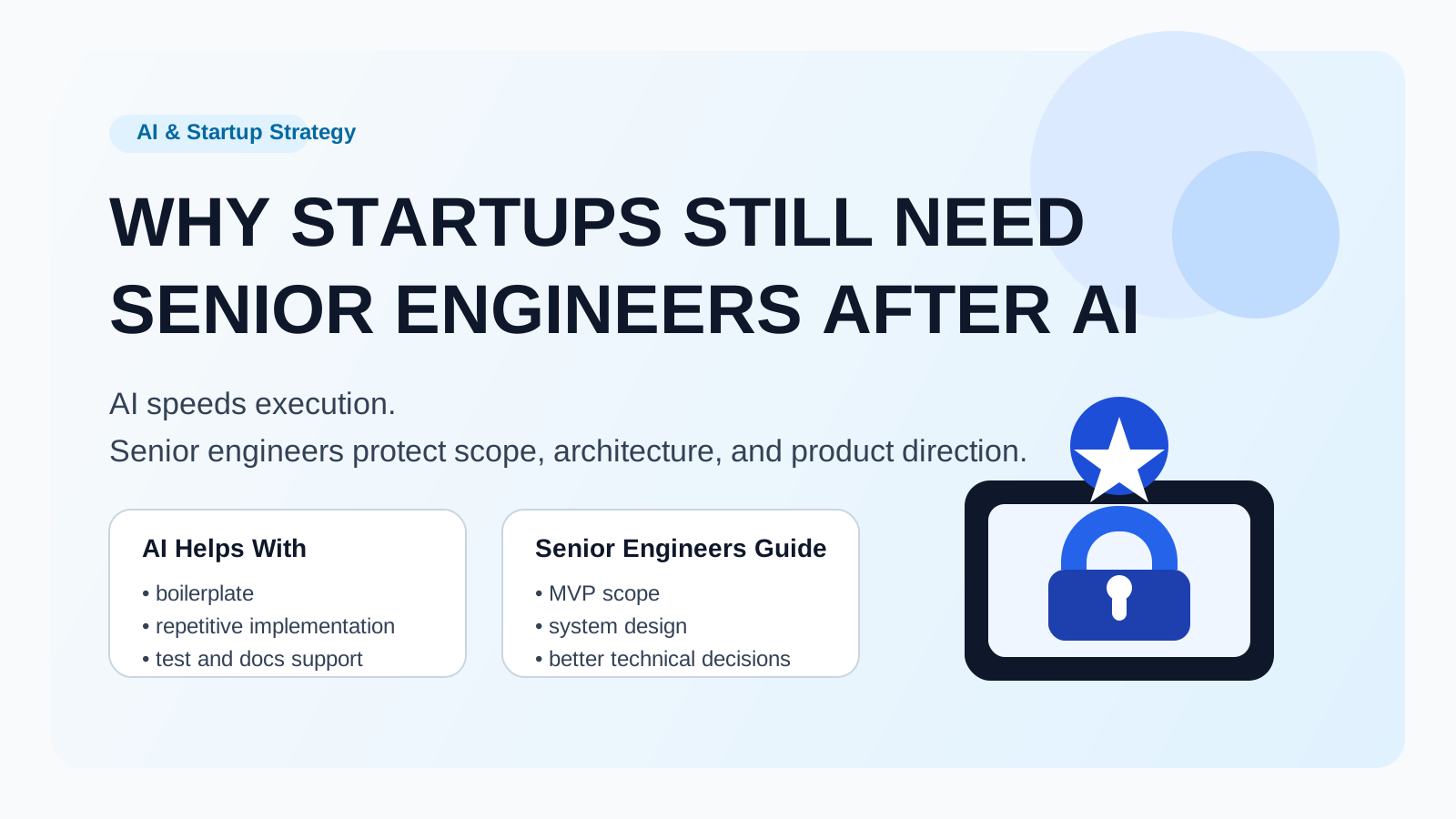
It helps teams move faster through:
- boilerplate code
- repetitive implementation
- documentation drafts
- refactoring assistance
- debugging support
- test generation
That is useful.
It also creates a tempting conclusion:
If AI makes coding easier, maybe startups need fewer senior engineers.
On the surface, that sounds logical.
In practice, it is usually wrong.
Because startups do not fail only because code was written slowly.
They fail because the wrong product gets built, the wrong scope gets approved, the system becomes messy too early, or the technical foundation cannot support what the business needs next.
That is exactly where senior engineers still matter.
AI Reduced Some Execution Friction, Not Product Risk
AI can reduce the time it takes to produce code.
It does not remove the risk of:
- building the wrong features
- choosing the wrong architecture
- overcomplicating the MVP
- introducing technical debt too early
- creating workflows that do not match the business
- making scaling harder than it needs to be
For startups, these are the real risks.
A startup usually does not lose because one endpoint took too long to write.
It loses because:
- the MVP is overbuilt
- the core user flow is wrong
- the data model is fragile
- permissions are poorly thought through
- integrations were added too early
- or the product cannot evolve without rework
AI does not solve those decisions.
Senior engineers help reduce those mistakes.
Startups Need More Than Code
Early-stage founders often think they need developers.
Sometimes they do.
But more often, they need:
- technical judgment
- scope control
- systems thinking
- architectural clarity
- tradeoff decisions
- someone who knows what to delay
That is the value of senior engineering.
A senior engineer does not only ask:
"Can we build this?"
They ask:
- Should this be in the MVP?
- What happens if we scale this workflow later?
- Is there a simpler way to solve this?
- What dependencies does this create?
- What can safely wait until phase two?
- What will create expensive rework if we get it wrong now?
Those questions protect startup time, budget, and momentum.
Senior Engineers Help Startups Avoid False Progress
One of the biggest dangers after AI is false progress.
A team can now generate a lot of software quickly and still move in the wrong direction.
That can look productive:
- more screens
- more features
- faster demos
- more code committed
But none of that guarantees the startup is becoming more viable.
Senior engineers help startups focus on:
- the core workflow
- the smallest launchable product
- the strongest product assumptions to test
- the cleanest technical base for the next phase
That is why senior engineering is not mainly about writing “better code.”
It is about protecting the product from avoidable confusion.
Where Senior Engineers Matter Most in a Startup
1. MVP scoping
Many startup products fail before launch because the first version tries to include too much.
Senior engineers help cut through that by identifying:
- what is essential
- what is optional
- what creates hidden complexity
- what belongs later
This is one of the highest-value things a startup can get right early.
2. Architecture decisions
Startups do not need overengineering.
But they also do not need a fragile structure that collapses as soon as the product grows.
Senior engineers know how to balance:
- speed
- stability
- future flexibility
That balance matters more after AI because teams can build very quickly on top of weak assumptions.
3. Workflow design
A startup product is not just a collection of screens.
It is a set of workflows:
- signup
- onboarding
- permissions
- billing
- approvals
- notifications
- reporting
Senior engineers help make sure those workflows actually fit the business model instead of only looking good in a demo.
4. Integration timing
Founders often want every integration early:
- CRM
- payments
- analytics
- automation
- email tools
- ERP
Senior engineers know when integrations add real value and when they only add complexity before the product has earned it.
5. Delivery discipline
Startups need movement, but they also need disciplined decision-making.
Senior engineers help maintain:
- milestone clarity
- better sequencing
- cleaner tradeoff calls
- fewer reactive decisions
That makes the product easier to launch and easier to improve.
AI Makes Senior Engineers More Valuable, Not Less
This sounds counterintuitive, but it is important.
When implementation becomes faster, the quality gap shifts upward.
The real difference between teams is no longer only:
- who can write code
- who can scaffold a feature
- who can ship a UI quickly
It becomes:
- who can make stronger product decisions
- who can structure the system well
- who can avoid future pain
- who can keep the startup moving without creating technical confusion
That is why senior engineers matter more now.
They help direct the speed that AI creates.
Without that direction, startups can simply build the wrong product faster.
What Founders Should Ask Instead
If you are evaluating a development partner after AI, better questions are:
- How do you decide what belongs in the MVP?
- How do you keep a product lean without making it weak?
- How do you think about workflows and permissions?
- How do you avoid rebuild risk?
- How do you balance speed and maintainability?
- How do you use AI without letting it lower product quality?
Those questions tell you much more than:
- How many developers do you have?
- What tools do you use?
- Can you build fast?
Speed matters.
But startups usually need judgment more than raw speed.
The Best Startup Teams Will Combine Both
This is not an argument against AI.
The strongest teams should absolutely use it.
The real advantage is not:
- AI alone
- or senior engineering alone
It is the combination of:
- faster execution
- stronger product judgment
- cleaner architecture
- better systems thinking
That is what helps startups move quickly without creating chaos.
Final Thoughts
Startups still need senior engineers after AI for the same reason they needed them before:
not because coding is hard,
but because building the right product, in the right way, at the right stage is hard.
AI can help teams move faster.
Senior engineers help startups move in the right direction.
And for an early-stage company, that difference is often the one that matters most.
Need a Product-Minded Technical Partner?
At MarqueFactory, we use modern tooling, including AI-assisted workflows, but our real value is not just writing code faster.
It is helping founders and businesses make better decisions about:
- MVP scope
- product architecture
- systems and workflows
- integrations
- long-term maintainability
If you need a senior technical partner for an MVP, SaaS platform, or custom product build, book a consultation.
You can also explore: