What Vibe Coding Cannot Do: The Real Limits of AI-Generated Code
Vibe coding is real, and it works — up to a point.
Tools like Cursor, Bolt, Lovable, and v0.dev have genuinely changed what a solo founder can build in a weekend. Non-technical people are shipping prototypes that would have taken a hired developer weeks just two years ago.
That is impressive.
But there is a pattern emerging that nobody talks about honestly:
Founders build a working prototype with AI tools, show it to investors or early users, get validation — and then the product falls apart the moment real usage begins.
Not because the founder is incompetent.
Because there are specific things vibe coding cannot do, and most founders do not discover them until it is too late.
This is not an argument against AI tools.
It is a clear-eyed look at where they stop, so you can plan for what comes next.
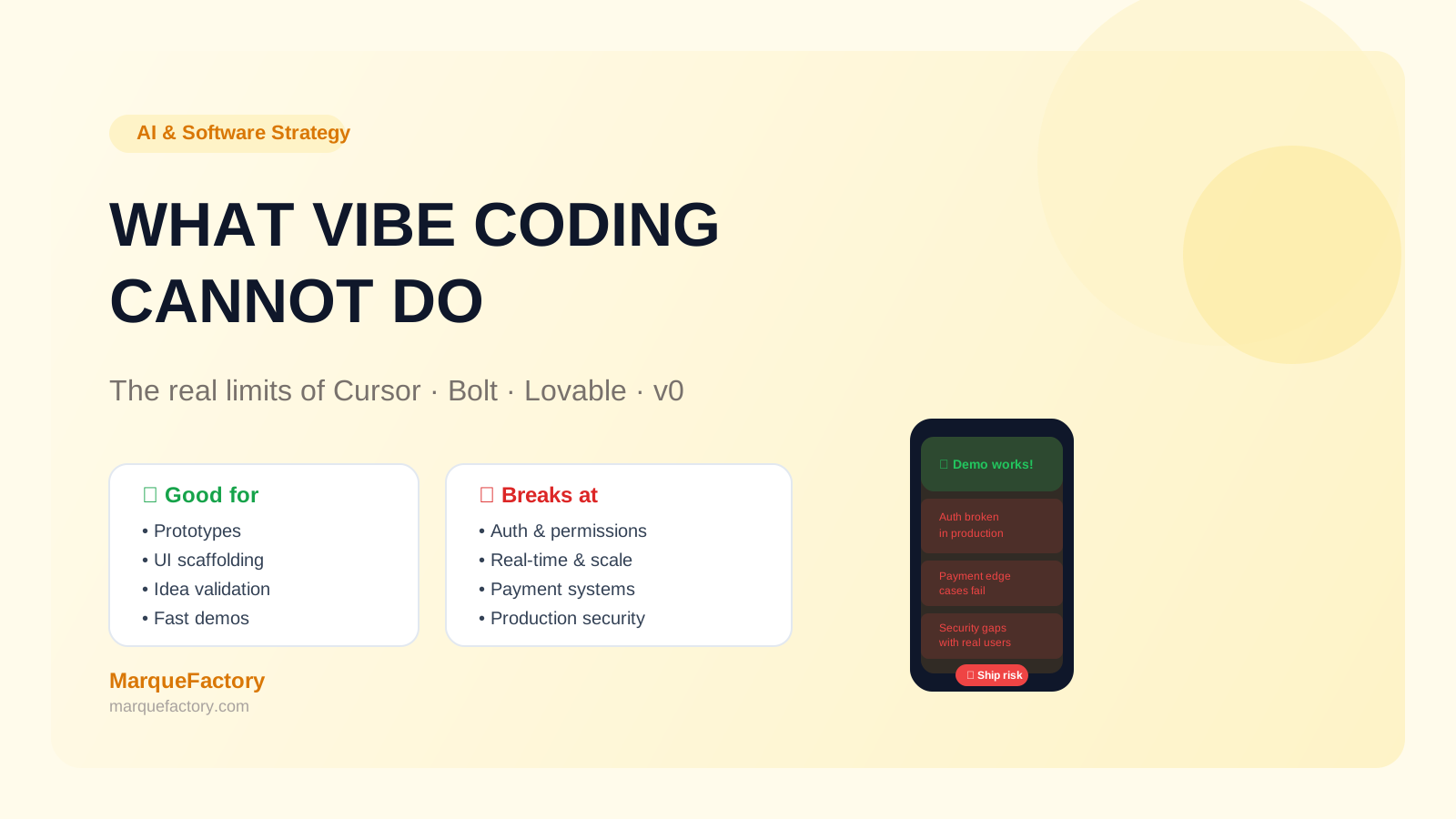
What Vibe Coding Is Actually Good For
Before getting to the limits, it is worth being honest about where AI code generation works well:
- Building a visual prototype to test an idea
- Generating standard UI components quickly
- Producing boilerplate CRUD operations
- Creating a demo for investors or user interviews
- Exploring technical feasibility before committing resources
- Moving faster through known, repetitive patterns
These are real advantages.
If you need to validate whether anyone wants your product, AI tools can compress weeks of UI work into days.
The problem starts when a prototype needs to become a product.
Where Vibe Coding Breaks Down
1. Multi-Role Authentication and Permissions
Most real products have more than one type of user.
A food delivery app has customers, restaurant owners, drivers, and administrators.
A SaaS platform has free users, paid users, team admins, and super admins.
An internal tool has employees, managers, and read-only auditors.
AI tools can generate a login screen.
They cannot reliably design a permission system that correctly controls what each role sees, does, and cannot do — especially as those rules interact with each other.
This is not a UI problem. It is a systems design problem.
What happens in production:
- A restaurant owner accidentally sees another restaurant's orders
- A driver can modify customer records they should not access
- An admin deletion cascades incorrectly and corrupts related data
- A free-tier user accesses premium features because a permission check was missing
These are not edge cases. They are the default outcome of AI-generated auth that has not been properly designed.
2. Real-Time Features Under Load
Prototypes do not have real users.
When you demo a delivery tracking feature or a live dashboard to five people in a meeting, it works fine.
When one hundred customers are actively ordering at the same time, the system behaves differently.
Real-time features — order status updates, live tracking, WebSocket connections, push notifications, concurrent state changes — require deliberate architecture decisions that AI tools do not make.
They generate code that works in isolation.
They do not generate code designed for simultaneous users, reconnection handling, race conditions, or graceful degradation when a connection drops.
3. Mobile App Publishing — iOS and Android
Generating mobile app code with an AI tool is straightforward.
Getting that app approved and published on the Apple App Store and Google Play is not.
Apple and Google have specific requirements around:
- Privacy policy declarations
- Data usage explanations
- Permission request justifications
- In-app purchase compliance (Apple takes 30%)
- Age rating classifications
- Binary submission format and signing
- Review guidelines that change and get enforced unpredictably
Beyond submission, the ongoing maintenance of a published mobile app requires:
- Handling OS version compatibility as iOS and Android update
- Managing app store review cycles for every release
- Understanding rejection patterns and how to respond
- Certificate management and renewal
- Push notification certificate rotation
Vibe coding tools generate a React Native or Flutter UI.
They do not navigate the App Store or Play Store process, and they do not maintain what happens after the first approval.
4. Payment Integration at Production Scale
Adding a Stripe payment form to a prototype is easy.
Building a payment system that handles real money correctly is different.
At production scale, you need:
- Webhook handling — Stripe sends events asynchronously. Your server must receive, verify, and process them reliably even when they arrive out of order or are retried.
- Idempotency — A user clicking "pay" twice should not result in two charges.
- Subscription lifecycle logic — What happens when a card expires mid-subscription? When a trial ends? When a user downgrades?
- Refund and dispute workflows — Chargebacks have strict response windows.
- Tax handling — EU VAT rules, UK VAT post-Brexit, and US sales tax by state are genuinely complex.
- Revenue recognition — For SaaS especially, when revenue is recognised matters legally.
AI tools generate a Stripe Checkout integration.
They do not generate a billing system that handles edge cases correctly under real business conditions.
A payment bug is not a minor issue. It is either a financial loss or a compliance problem.
5. Database Design for Complex Business Logic
The data model is the foundation of every product.
Get it wrong early, and every feature you build afterwards fights against it.
AI tools generate tables and schemas that match the prompt.
They do not ask:
- What happens when an order is cancelled after a refund has been issued?
- How will you query historical data across millions of records without full table scans?
- What indexes are needed for the most common access patterns?
- How do you handle soft deletes without polluting active data queries?
- What foreign key constraints protect against orphaned records?
- How do you model a product that can belong to multiple categories without creating duplication problems?
These decisions seem unimportant in a prototype with ten records.
They become very expensive to fix at ten thousand records.
A poorly designed data model does not fail loudly. It fails gradually — with slow queries, inconsistent reports, and features that are hard to build correctly because the underlying data structure does not support them.
6. Security at the API Layer
AI-generated backends often have predictable security gaps:
- Missing rate limiting — An attacker can brute-force login endpoints or abuse free-tier APIs at scale
- Insecure direct object references — A user changes an ID in a URL and accesses another user's data
- Missing input validation — Malformed requests crash the server or expose stack traces
- Exposed environment variables — Secrets committed to repositories or visible in client bundles
- No CSRF protection — Forms can be submitted from external sites
- Logging sensitive data — Passwords, tokens, or payment data written to logs
None of these break a prototype.
All of them become serious problems when the product has real users and real data.
7. Production Infrastructure and Deployment
Running an app locally is not the same as running it reliably for users across different devices, locations, and usage patterns.
Production infrastructure involves:
- Server configuration and hardening
- SSL certificate management
- Reverse proxy setup (Nginx, Caddy)
- Environment variable management in production
- Database connection pooling
- Error monitoring and alerting
- Log aggregation
- Backup and recovery procedures
- Scaling strategy when load increases
AI tools can generate a Dockerfile.
They do not design a production environment that stays up, recovers from failures, and scales when needed.
8. Long-Term Maintenance
AI-generated code is often inconsistent.
Different parts of the codebase use different patterns, different naming conventions, and different error-handling approaches — because each session with the AI tool starts fresh.
Over time, this creates a codebase that:
- Is difficult for any developer to read and extend
- Has inconsistent error handling that hides bugs
- Contains duplicate logic that gets updated in one place but not another
- Has no clear structure that future developers can follow
The prototype works.
The codebase becomes a liability when you need to iterate, fix production bugs quickly, or hand it to a new team member.
Signs You Have Outgrown Vibe Coding
You have probably hit the ceiling if:
- The prototype works but you cannot explain why certain parts behave the way they do
- You are afraid to change code in one area because something unrelated breaks
- Adding a new feature takes longer each time because nothing is predictable
- You have real user data and are not confident it is secure
- A developer looked at the code and said it needs to be rewritten
- Payments, notifications, or real-time features are behaving inconsistently
None of this means the AI tool failed.
It means the product has grown beyond what a prototype was designed to handle.
What to Do Next
Moving from an AI-generated prototype to a production system is a real transition.
It usually involves:
- Architecture review — Identifying what can be kept, what should be rewritten, and what risks exist in the current code
- Data model audit — Checking whether the existing schema will support the product roadmap
- Security review — Finding and closing the predictable gaps before real users are affected
- Infrastructure planning — Building a deployment setup that is reliable and maintainable
- Feature planning against a real foundation — Building new features on top of a solid base instead of continuing to extend a fragile one
This is not about discarding what the prototype proved.
The prototype validated the idea. That has real value.
The next step is building the system that can deliver on it.
The Honest Position
AI tools lowered the barrier to starting.
They did not lower the bar for what a production-ready product needs to be.
The founders who use vibe coding well treat it as a discovery tool, not a delivery tool.
They use it to validate assumptions, explore ideas, and move fast before product-market fit is confirmed.
Then they bring in senior engineering judgment to build the product that can actually scale.
That combination — fast validation followed by solid engineering — is still the most practical path from idea to product.
Working With MarqueFactory on a Vibe Coding Rescue or Rebuild
If you have a prototype built with AI tools and need to move it to production, or if the current codebase is creating problems that are slowing you down, we can help.
We regularly work with founders who have validated their idea and need a technical partner to build the real product.
That means:
- Reviewing what exists and being honest about what is worth keeping
- Designing the right data model, permission system, and API structure
- Building for production from the start — not retrofitting quality in later
- Delivering in clear phases so you can stay moving while the product improves
Book a free call to discuss your project
You can also explore: